




Categories
- Case Study (12)
- Industrial Building (5)
- ESG (28)
- Fit-Out (3)
- News (61)
- Interior Architecture (11)
- Architecture (24)
- Office (51)
- Studio Alliance (29)
- History (3)
- Design (22)
- Technology (15)
- Artificial Intelligence (AI) (5)
AI-powered construction site monitoring is transforming quality control processes across the construction industry. Traditional inspection methods based on manual supervision are both time-consuming and prone to human error. In contrast, AI-driven systems enable real-time, measurable, and sustainable quality tracking on construction sites. In this article, we examine how artificial intelligence makes construction quality systematic, traceable, and sustainable through five critical steps.
AI-powered site monitoring refers to the automated observation and analysis of all on-site activities through camera systems, sensors, drones, and data analytics tools.
These systems enable:
Particularly in large-scale and multi-stakeholder projects, digital construction management is no longer optional—it is a necessity.
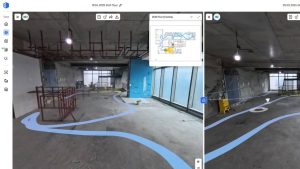
Effective site monitoring begins with accurate and continuous data. AI systems collect data from the field 24/7, enabling instant analysis and response.
Common tools include:
With these technologies, processes ranging from concrete pouring to occupational safety can be monitored simultaneously and in real time.
AI algorithms analyze incoming visual and operational data and compare it with project standards to automatically detect deviations and quality issues.
For example:
This approach shifts quality control from a reactive process to a proactive one.
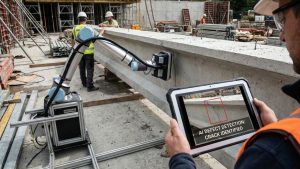
Quality is not only about workmanship—it also requires full compliance with regulations and technical specifications. AI systems continuously cross-check site activities against contractual requirements and legal standards.
As a result:
Integrated construction solutions, such as those provided by Diem, create a significant advantage in aligning quality and ESG objectives within project workflows.
Collected data is not only used for monitoring but also for strategic decision-making. AI-powered analytics reveal:
Unlike traditional site management that often relies on intuition, this model offers measurable and evidence-based project governance.
For further insight, you may also review our article titled The Role of Artificial Intelligence in Office Design and Construction: Innovation of the Future.
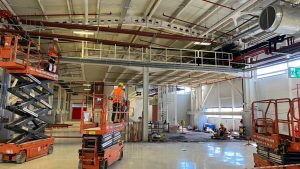
One of artificial intelligence’s strongest capabilities is its ability to learn and improve over time. With each completed project, the system becomes more accurate in its predictions and analyses.
Long-term benefits include:
When integrated with sustainable construction and ESG frameworks, AI-powered systems play a critical role in advancing environmental and operational performance.
For an academic perspective on AI’s impact in construction, you may review the Artificial Intelligence report by McKinsey & Company.
AI-powered construction site monitoring shifts quality control from manual inspections to a data-driven, continuously monitored management system. Through real-time data collection, automated error detection, and instant compliance tracking, quality becomes not just inspected—but actively managed. This approach reduces revision costs, improves workplace safety, and enhances schedule predictability. In the long term, AI-supported site management enables the construction industry to advance quality, efficiency, and sustainability objectives simultaneously.
👉 Diem’in yapay zeka destekli kalite ve ESG çözümlerini ESG-focused design services.


