


Categories
- Case Study (12)
- Industrial Building (4)
- ESG (24)
- Fit-Out (3)
- News (56)
- Interior Architecture (11)
- Architecture (22)
- Office (45)
- Studio Alliance (24)
- History (2)
- Design (20)
- Technology (13)
- Artificial Intelligence (AI) (4)
As the housing crisis becomes an increasingly growing problem, especially in major cities, the reassessment of existing building stock stands out as a critical solution. At this point, office conversion draws attention through its rapid applicability and sustainability. Converting vacant or inefficiently used office spaces into housing creates a new realm of opportunity for cities.
In recent years, rising costs and limited land production have severely restricted housing supply, while hybrid and remote working models have lowered office occupancy rates.
Today, in many cities:
This situation makes it mandatory to evaluate offices for alternative usage scenarios.
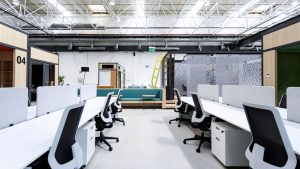
Office conversion is the process of adapting buildings originally intended for commercial use into residential functions. This process involves more than just a change in floor plans; it signifies a complete re-envisioning of the user experience.
As of 2026, architecture and office design are being shaped not just by functionality, but by a focus on user experience and sustainability. To examine this transformation in more detail, you can take a look at our article on the trends defining office and architectural design in 2026.
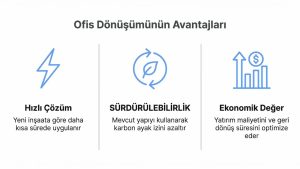
Converting an existing building instead of constructing a new one significantly shortens the project timeline.
Repurposing idle offices accelerates the return on investment (ROI).
Reactivating central business districts with residential integration strengthens urban life.
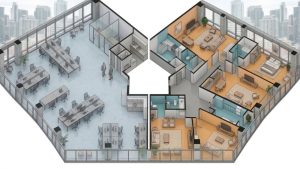
Not every office building is suitable for residential conversion. The following criteria are decisive for a successful transformation:
Modern design approaches center on user needs. To see how this approach has evolved, you can review our article where we discuss the office experience through the lens of emotions.
In conversion projects, the following must be readdressed:
Today, the boundaries between living and working are becoming increasingly blurred. Therefore, in conversion projects, the layout of the workspace is becoming just as important as the living area.
According to 2026 trends, the following are coming to the forefront:
The approach to flexibility in office design is now becoming an integral part of residential design as well.
For cities seeking a solution to the housing crisis, office conversion offers a fast, sustainable, and economic alternative. With the right analysis and design approach, existing office structures can be transformed into the living spaces of the future.
Click here to get detailed information about office conversion projects and to review our portfolio.
Discover Diem’s sustainable design approach.


