



Categories
- Case Study (12)
- Industrial Building (4)
- ESG (26)
- Fit-Out (3)
- News (57)
- Interior Architecture (11)
- Architecture (22)
- Office (46)
- Studio Alliance (24)
- History (2)
- Design (20)
- Technology (13)
- Artificial Intelligence (AI) (4)
By 2026, offices that reduce their carbon footprint are no longer driven solely by environmental sensitivity—they have become a core decision criterion in office design. High energy consumption, poor material choices, and inefficient spatial layouts increase operational costs while creating significant long-term environmental impact. Well-planned offices, on the other hand, can reduce carbon emissions while simultaneously improving employee comfort and overall spatial performance. This approach turns sustainability from an abstract concept into a measurable and actionable part of design.
A carbon footprint refers to the total amount of greenhouse gases released directly and indirectly into the atmosphere by a space, product, or service. In offices, this footprint is influenced by multiple factors, including:
A poorly designed office can generate high carbon emissions for decades, while a well-planned one can significantly reduce its environmental impact over time.
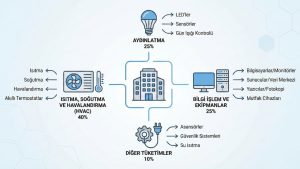
Offices that reduce carbon footprint benefit not only the environment but also organizations directly:
For details on these certificates, you can review our previous blog post.
Especially in post-2026 office projects, sustainability is no longer treated as an “extra”—it is a fundamental design requirement.
A sustainable office design begins with accurate analysis. Decisions made without data on electricity, heating, cooling, and equipment usage are often assumption-based. The first step should always be mapping the office’s energy consumption profile and identifying areas with the highest carbon emissions. This analysis defines which design interventions will actually create impact.
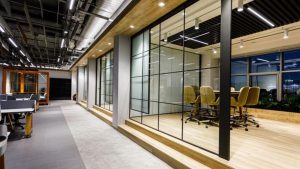
Daylight is one of the most powerful tools in reducing office carbon footprint. Positioning work areas close to façades while placing meeting rooms and service spaces deeper inside significantly reduces the need for artificial lighting. At the same time, daylight access improves employee comfort, focus, and overall well-being.
LED lighting, motion sensors, and daylight-responsive systems optimize energy use. In frequently occupied areas, sensor-based solutions prevent unnoticed energy waste. Lighting design should be based not only on fixture selection, but also on real usage scenarios.
Material selection has a long-term impact on an office’s carbon footprint. Recycled-content materials, locally sourced products, and low-VOC finishes reduce environmental impact while improving indoor air quality. In low-carbon offices, aesthetics matter—but life-cycle performance matters more.

Heating, cooling, and ventilation systems account for the highest energy consumption in offices. Smart thermostats, zone-based control, and time-based scenarios ensure that only occupied areas are conditioned. This approach reduces both carbon emissions and operational costs.
Recycling zones should not be added later—they should be embedded into the initial office layout. Clear, accessible separation points for paper, plastic, and organic waste encourage participation and make sustainable behavior easier. Design should actively support sustainable habits.
Offices that adapt over time are more sustainable. Modular furniture systems allow reuse and reconfiguration, reducing waste and preventing frequent replacements. Instead of fixed and short-lived solutions, long-term usage scenarios should guide furniture decisions.

Low-carbon offices are shaped not only by technical systems but also by user behavior. Bicycle parking, shared social spaces, and amenities that support alternative transportation encourage environmentally responsible habits. Sustainability becomes more effective when it is visible and accessible.
Spaces that require frequent renovation carry high carbon costs. Durable materials, easy-maintenance solutions, and timeless design decisions reduce environmental impact across the entire life cycle of the office. Carbon footprint is created not only during construction—but throughout daily use.
Truly sustainable offices continuously monitor performance. Without tracking energy consumption, water usage, and waste generation, meaningful improvement is not possible. Setting measurable targets transforms sustainability from a concept into a manageable system.
Our 2023-2024 ESG Report here , you may find.
Offices that reduce carbon footprint are achievable through informed planning and conscious design decisions. What may seem like small steps can lead to major environmental and economic gains over time.This checklist offers a strong starting point for making your office more sustainable.
To reduce your carbon footprint, explore Diem’s sustainable office and ESG-focused design services.


