


Categories
- Case Study (12)
- Industrial Building (4)
- ESG (26)
- Fit-Out (3)
- News (60)
- Interior Architecture (11)
- Architecture (22)
- Office (46)
- Studio Alliance (26)
- History (3)
- Design (20)
- Technology (13)
- Artificial Intelligence (AI) (5)
Urban life is weakening our bond with nature every single day. However, one of the most powerful agendas in modern architecture and design is no longer about "reproducing" nature, but rather working with it. The micro-nature approach offers a way to reverse this disconnect by establishing sustainable ecosystems in compact spaces.As we celebrate Earth Day on April 22nd, we are reminded of a fundamental truth: we are not separate from nature; we are an inseparable part of it. Micro-nature is not just a design trend—it is a commitment to protecting the planet’s health at a localized scale.
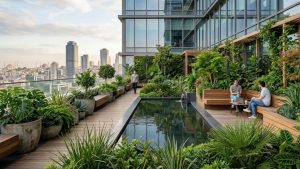
Micro-nature is more than a landscaping approach involving a few potted plants; it is a deliberate ecosystem configuration. These systems, which can be applied to anything from balconies to office terraces, aim to create self-sustaining areas by mimicking the inner workings of nature.
In recent years, this approach has become increasingly visible in sustainability-focused projects. Design decisions are no longer evaluated solely on aesthetics but on their environmental footprint.
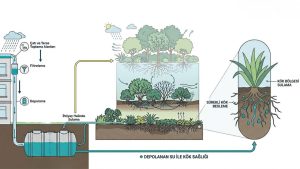
What makes World Water Day so significant is the reminder that water is not just a resource—it is the circulatory system of the entire environment. Micro-nature systems function as small but effective water management models.
A well-structured system:
This aligns perfectly with a sustainability-driven perspective, where minimizing environmental impact is the primary objective in every project developed.
While "mini-forestry" is often associated with large-scale regional projects, the real impact begins in small spaces. Whether it’s an office terrace, a campus corner, or a social hub—when designed correctly, these areas can create their own microclimates.
This transformation runs parallel to the evolution of workspaces. As noted in our recent piece, “10 Architectural Trends That Will Shape Office Design in 2026,” integrating nature into built environments is becoming a critical necessity rather than a luxury.
The most powerful principle of micro-nature design is not to copy how nature looks, but to understand how it works. Plants are treated as components of a living system rather than isolated decorative elements.
Through a layered structure (ground cover, shrubs, and trees):
This approach allows for maximum efficiency with minimum intervention.
Beyond ecology, these are experiential spaces. They forge a direct link between the user and the natural world.
A strategy detailed in our guide on “7 Office Design Strategies to Increase Individual Focus.”
Today, the practice of architecture is about more than just constructing buildings; it’s about designing systems that function in harmony with their surroundings.
Within the scope of Diem’s design and consultancy services, projects—ranging from offices to industrial facilities and public spaces—are handled with a focus on sustainability, efficiency, and the user experience.
Micro-nature is a vital part of this holistic vision because "good design" now requires creating systems that don't just look good, but work well.
Micro-nature and mini-forestry represent a meaningful promise we can make to our planet: "We start healing it from the spaces closest to us." Every small green zone, if designed correctly, helps the global ecosystem breathe.
To learn more about how we design sustainable spaces that work with nature, feel free to explore our ESG approach.


